

READ ALL ABOUT IT
Since 2012, I’ve been writing about books. And the act of reading. And the importance of story and narrative. But, mostly, the underlying theme of all I write is how taking a moment to stop and digest some longform text — instead of scrolling, instead of watching a video, instead of multitasking — can be one of the most grounding things we can do for ourselves. Here’s the one-stop online home for all this writing.
You can read more about me and my work by moseying over here. Want to peruse periodic “essay drops” — excerpts from my work-in-progress essay collection about Homesickness? Here ya go.

Planes, Trains, and Automobiles: Amy’s Version
Planes, Trains, and Automobiles: Amy’s Version. Matt and I have been in Charlotte for a few weeks but have taken turns going back to Massachusetts on weekends. This weekend was my turn, and when I got up at 4 am on Friday to get to the airport, I saw that my flight was cancelled. Flying to Boston was going to be essentially impossible until Monday. Not helpful! After going through possible parent-less scenarios (could our son Uber to our house from his school, get our car, and criss-cross New England alone to these appointments at colleges?), we decided I would fly into a different airport and figure out the last part when I landed.

Colleen Hoover, Crocs, and Bestseller Lists
So what are bestseller lists good for? I mean, I know they’re good for authors and publishers and might give a book a nice zeitgeisty pat on the back, but from a reader’s perspective…what’s the point? Are they “good” for readers? The number of books I’ve read in the past few years that I’d put in the “excellent” category *and* were on some sort of bestseller list is minuscule. #venndiagram

Reading Culture
I’ve been thinking about the interplay between a person helping to shape a culture versus a culture helping to shape a person. “Culture” meaning the shared beliefs and values of any subset of people, I suppose.

Weird Ideas
I’ve been mulling over these two quotes from the bottom of yesterday’s @literaryhub daily email. I like them not just because they resonate with me as a writer, but they force me to reckon with why a book is “good” (in my eyes) or not. I love reading things that take me to unexpected places (I don’t mean that in a #readinginspo travel-via-reading kind of way) — writing that makes me go, “I would never have dreamed of mixing those words up like that.”

Remote Control
I’ve been thinking about “active” reading, not just a let-the-story-wash-over-me thing. It’s on my mind because, lucky me, I got some (v minor) insights into student life recently.

St. Patrick’s Day with Roddy Doyle
“If you are a writer you're at home, which means you're out of touch. You have to make excuses to get out there and look at how the world is changing.” – Roddy Doyle

I Finally Read American Dirt
From Newsletter Issue No. 13:
Remember when a little novel called American Dirt by Jeanine Cummins was published in 2020? It was a much-anticipated work of fiction that was meant to shed light on and give voice to people who found themselves in the crosshairs of the migration crisis happening at the border between the United States and Mexico. Oprah selected it for her book club. Stephen King provided a blurb and called American Dirt “Extraordinary.” Sandra Cisneros (family roots in Mexico) and Julia Alvarez (family roots in the Dominican Republic) both praised the book.

Laura Zigman and Gap Khakis
In January, The Boston Globe published a story about the writer Laura Zigman. Maybe you remember her as the author of the bestselling 1998 novel Animal Husbandry. Or maybe you just remember the movie adaptation called Someone Like You starring Hugh Jackman and Ashley Judd. When I think of Animal Husbandry, I think of chick lit that was more literary than what is currently marketed that way. Remember the 1999 novel A Girl’s Guide to Hunting and Fishing by Melissa Bank? To me, these two novels — plus Bridget Jones’ Diary by Helen Fielding — encapsulate a specific late 90s vibe. They were like the literary world’s version of Gap’s dancing-in-khakis ads.

Snow-Bound: A Winter Idyl
We’ve got another snowy day today, and I’ve been thinking about how snow is often romanticized. Don’t get me wrong: There is something so satisfying about “tucking in” and feeling unburdened by the rigmarole of daily life. Especially if it’s over a weekend; today is Saturday. Somehow Laura Ingalls Wilder even managed — in the rose-colored, made-for-publishing view of her childhood — to make The Long Winter seem dreamy.

Frances Ellen Watkins Harper
The NYT’s “Overlooked” column, “a series of obituaries about remarkable people whose deaths, beginning in 1851, went unreported in The Times” — has got to be one of the most interesting recurring features in a daily newspaper. (Just my 2c.) I’ve posted about different ones before, including Theresa Hak Kyung Cha (author of Dictee). This one, about the 19th-century Black poet Frances Ellen Watkins Harper, was published toward the beginning of February, Black History Month.

Through the Window
Nearly 10 years ago, I read this: “…writing is a matter of examining the world, reflecting upon it, deducing what you want to say, putting that meaning or message into words whose transparency allows the reader, now gazing through the same window-pane from the same position, to see the world exactly as you have seen it.” – Julian Barnes, Through the Window: Seventeen Essays and a Short Story

What a Reader Wants
“That’s all a reader really wants — to know the author better. Even if it’s a novel, they want to know the author.” – the novelist Cecil Dawkins to Natalie Goldberg.

Let’s BeReal
From Newsletter Issue No. 12:
Sometime this autumn, I became a BeReal-er. (I just made up that term. We have TikTokers, so what shall we call people who use the app BeReal?) If you’re not familiar, BeReal sends a notification at a different (i.e. unexpected) time each day to all users with the cue, “It’s time to BeReal!” Users then take a photo of whatever they’re doing, wherever they are at the moment — simultaneously, the app takes a quick snapshot of your face. Here's a rundown of the app from the New York Times Magazine back in August.

Turning Nairobi’s Public Libraries Into ‘Palaces for the People’
Here’s a NYT article about the McMillan Library in Nairobi and how a dedicated group of organizers and fundraisers have gone about restoring the colonial-era institution — initially serving only white patrons — and turning it, and other libraries like it, into “palaces for the people.” According to Keynan publisher Angela Wachuka, “…we are here to also reclaim history, to occupy its architecture and to subvert its intended use.”

Sartorialists, Fashionistas, Readers
Survey says? 💃🎩🪡🧑🏽🎤

Literary Fandoms
Do you have a favorite author? I do. (Yes, I’m talking about Carol Shields again.) However, I can’t follow her on Twitter or subscribe to her newsletter because, well, she is deceased.

No Thanks to the Colleen Hoover Coloring Book
Two truths and a lie specific to this account:
* Salka Valka is my favorite Halldór Laxness book. (IYKYK)
* Favorite author = Carol Shields.
* I have read a Colleen Hoover book.
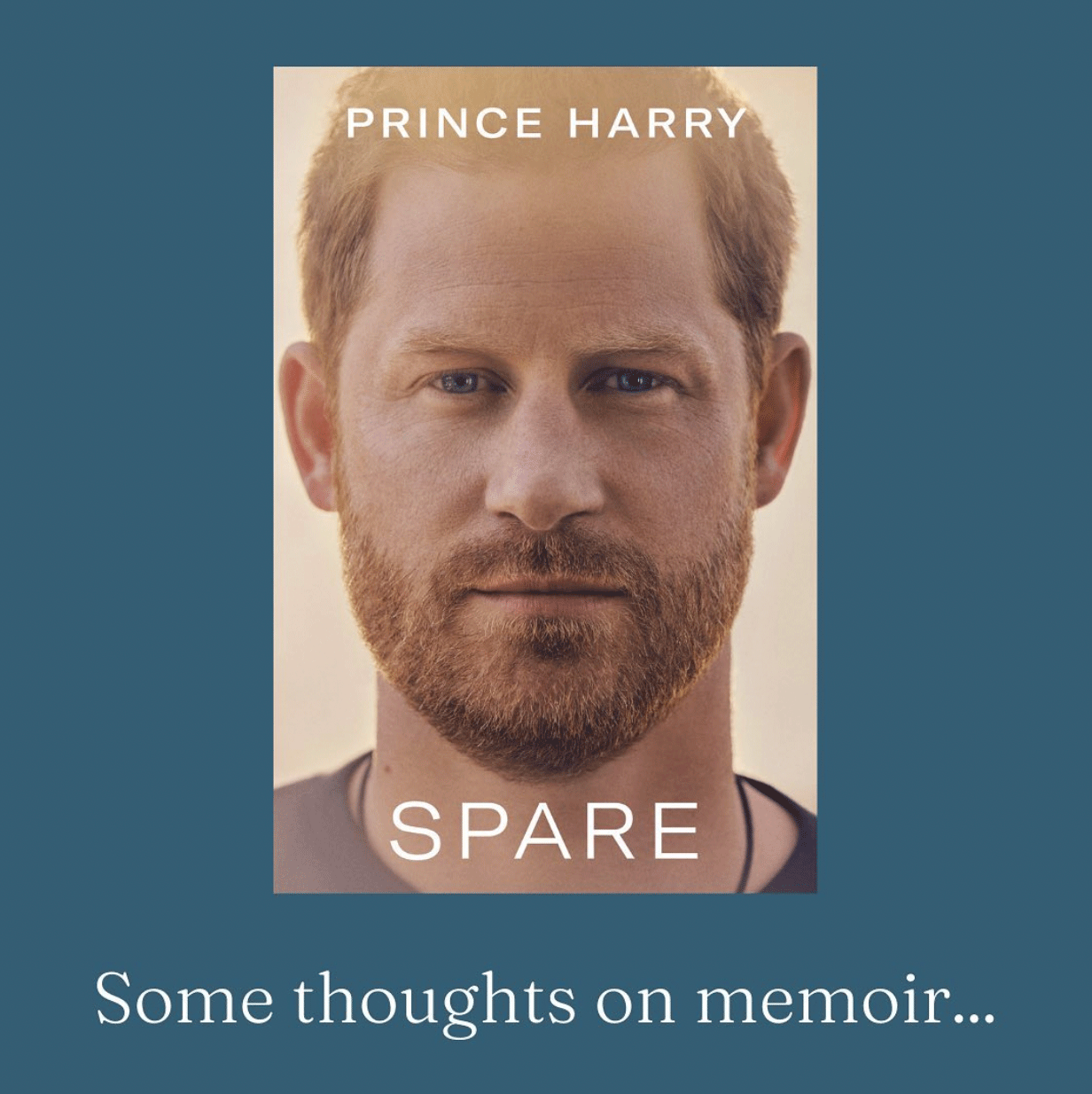
Memoir as Fantasy
Hello. In case you weren’t aware, there is a new tell-all memoir out called Spare. Have you heard of it?

A Book Prize From Those Behind Bars: Goncourt des détenus
As always, I’m spending too much brain space on this notion of celebrities becoming book pushers. So this NYT article from a couple of weeks ago was a nice change-up. The Prix Goncourt is France’s version of the Booker or the Pulitzer, but in some ways it might be more akin to being bestowed the Oprah stamp of approval: The monetary prize is only €10, but the payoff in book sales is considerable.

Curiosity > Accomplishment
Ahh, New Year’s Eve…the dawn of a New Life ™️. I truly love Jan. 1 — clean slate, fresh start — and do spend time thinking about how I’d like the impending year to unfold. Or rather, how I’d like to respond to how the year unfolds. I love a good quantifiable challenge —which, let’s face it, is what most people’s resolutions are — but I’m more interested in how an outcome might shape my outlook on life instead of just “I lost 5 pounds.” (Or, to tie in to this account: “I read 1,000 books.”)
