

READ ALL ABOUT IT
Since 2012, I’ve been writing about books. And the act of reading. And the importance of story and narrative. But, mostly, the underlying theme of all I write is how taking a moment to stop and digest some longform text — instead of scrolling, instead of watching a video, instead of multitasking — can be one of the most grounding things we can do for ourselves. Here’s the one-stop online home for all this writing.
You can read more about me and my work by moseying over here. Want to peruse periodic “essay drops” — excerpts from my work-in-progress essay collection about Homesickness? Here ya go.

The Wren, The Wren
R.E.M.’s album Green came out when I was in 7th grade — that was my “entry point” to the band. I nearly wore out my tape, lovingly dubbed by a friend, except there were all these whispers about it being a commercial sellout, but what did I know? I think it’s common to have a sweet affinity for the “thing” that introduces us to an artist, musician, writer. Often, we explore the back catalogue and then abhor anything that comes after our own particular entry point. It took me a long time to appreciate that Out of Time is, actually, a brilliant album. (Despite Shiny Happy People, which you know we all secretly love…)

Night Watch
With any crisis where one might feel somewhat removed, it takes a lot of self-imposed effort to (attempt to) understand what it’s really “like” to be in the center of it — whether that be due to time (a historical event) or location or any other seeming lack of connection with events. I find that bothersome (and I mean that about myself as well), but I suppose that’s human nature. We covet, crave, and glom on to what we know and what is familiar. I’ve been thinking about that a lot lately.
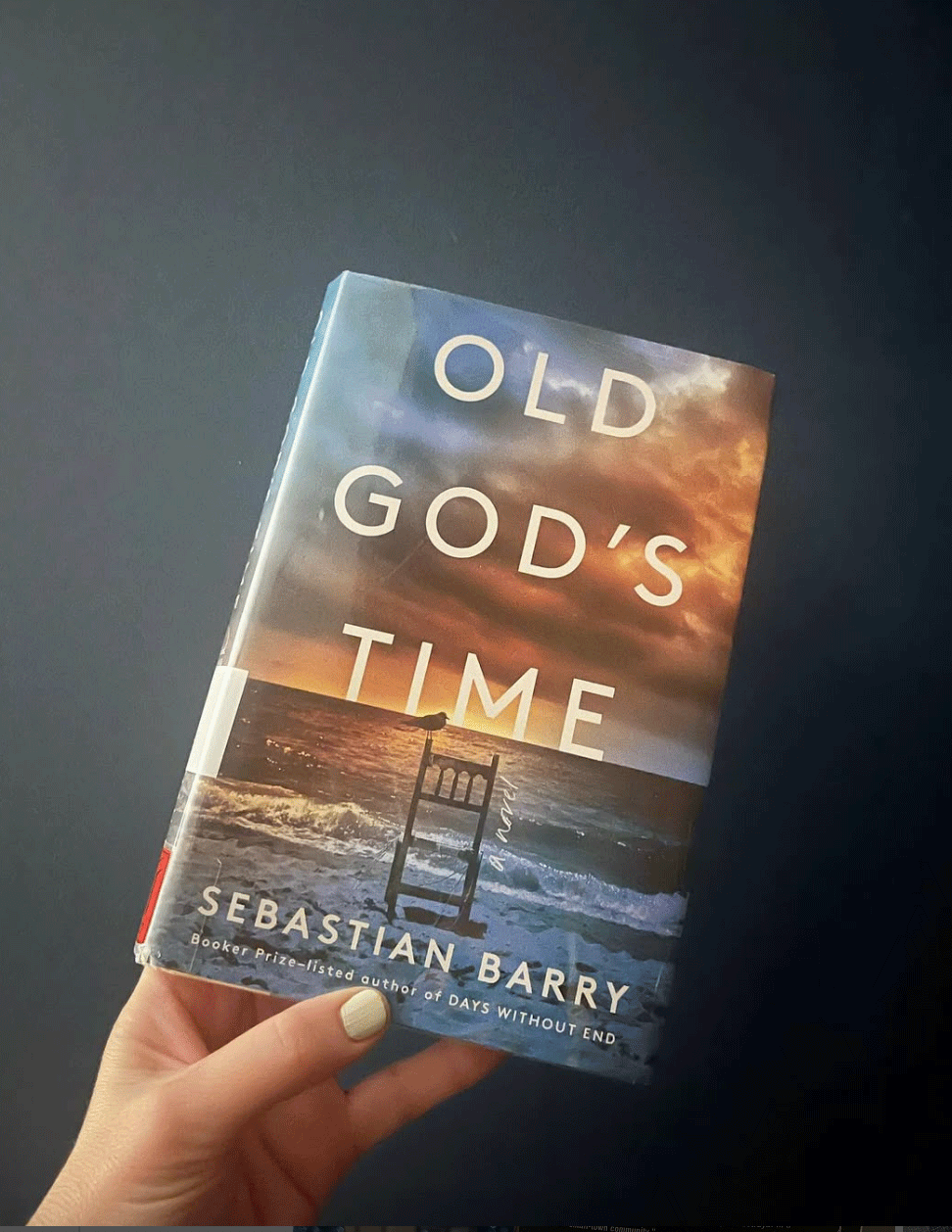
Old God’s Time
On the back of Old God’s Time, Sebastian Barry’s 11th novel, a blurb by Robert Gottlieb reads, “Barry’s novels give us lives, not plots…Every one of his novels is luminous. Not one of them sounds like anyone else.” Yup, yup on that “lives, not plots” commentary — and actually, I wrote about this very idea many years ago for The Curator after reading my first Barry novel. (It was Annie Dunne, purchased at the Dublin Writers Museum … here’s the piece.) These days, I’m more often than not drawn to “plot-less” books — books that mine emotion and motivation instead of relying on “and here’s what happened next” storytelling. But, as laid bare in that essay, I initially found reading a novel like that kind of jarring.
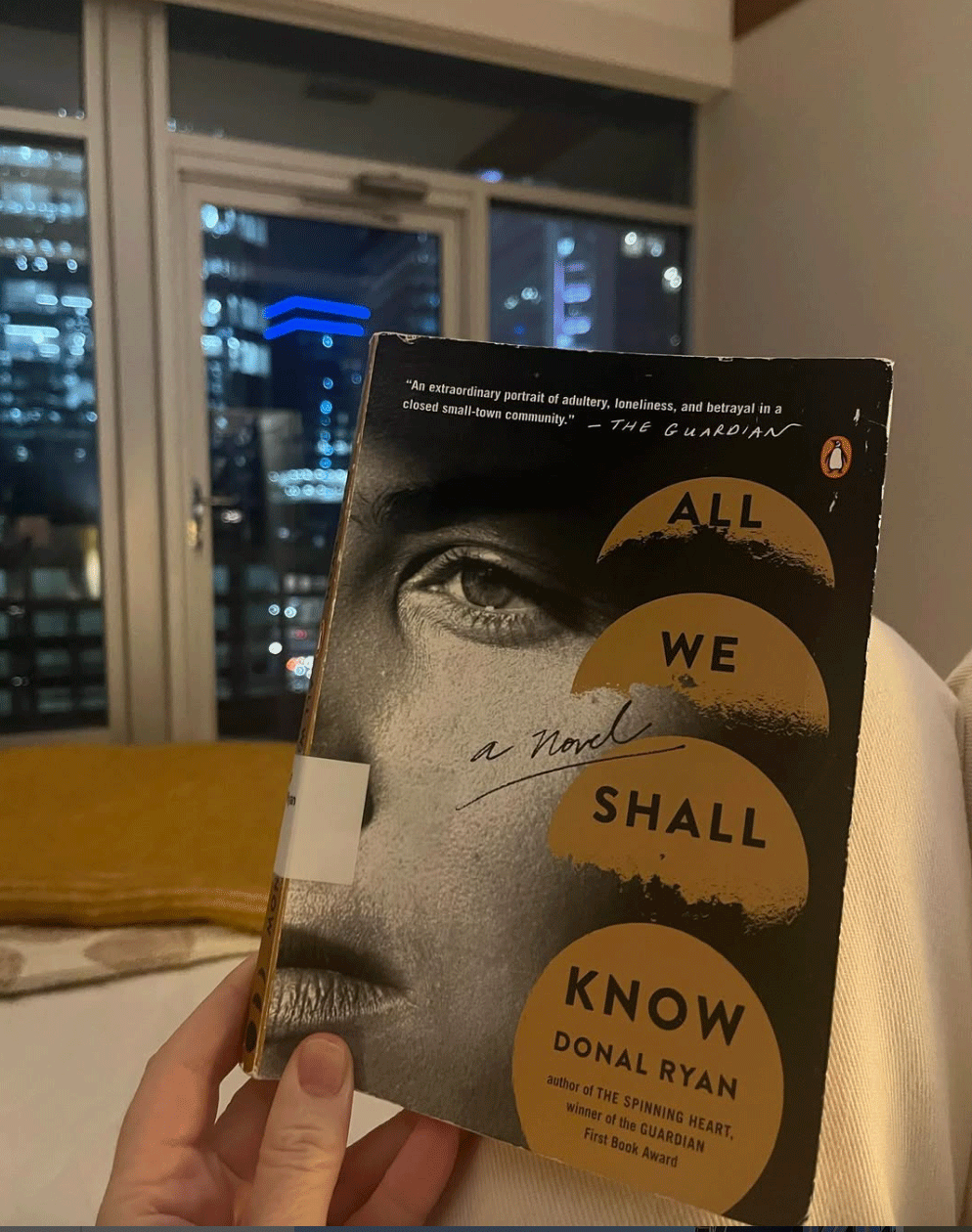
All We Shall Know
I love Donal Ryan’s work and can’t wait to read his latest, The Queen of Dirt Island. I lived in Ireland when The Spinning Heart and The Thing About December were published, and these will always be among my favorite books partly for the reason that they will transport me back to a specific era, a specific setting, a specific feeling…always. To me, they beckon like a gentle call of “remember this?” even though the setting, place, and politics aren’t really mine to claim.

The Shadow King
I have a fascination with random photos and ephemera, even if (especially if?) I have no connection to the people or events documented. Some examples of accounts I follow: @dear.fran, @oldirelandincolour, @oldschoolmoms, @owasowfoundphotos, @savefamilyphotos, @classicmyerspark. What others choose to document or save interests me to no end.

I Am Homeless If This is Not My Home
When you read something that sounds an awful lot like something you’d actively avoid — man takes his dead ex-girlfriend (who is now a zombie of sorts?) on a long road trip — but it’s coming from someone like Lorrie Moore…

Machine Dreams
I’ve muddled through this novel — Machine Dreams, by Jayne Anne Phillips — for the past three or four weeks. It’s not the book’s fault; it’s just been a really busy three or four weeks what with moving our children back to school and then moving ourselves about 850 miles away. This is Phillips’ debut novel, and although I had never heard of Phillips until about two months ago, she was apparently once associated with “the girls of Knopf” or a female version of the “literary brat pack” which included excellent company: Lorrie Moore, Louise Erdrich, Mona Simpson.

The Sheltering Sky
This was a fascinating book. Paul Bowles was unknown to me until a couple of months ago, but as you can see from this cover image of his novel The Sheltering Sky, this is a 65th anniversary edition with “a new introduction by Tobias Wolff” as well as a blurb from Dave Eggers. The Sheltering Sky was initially published in 1949, but to me if felt very Hemingway-esque — probably because the plot centers around an affluent and aimless American couple that finds itself wandering Northern Africa after WWII.

The Autobiography of My Mother
What I kept thinking about while reading The Autobiography of My Mother by Jamaica Kincaid was Sinéad O’Connor’s blockbuster album I Do Not Want What I Haven’t Got. It’s a long and convoluted album name — I once had a dubbed tape of the album and I wish I remembered if the friend who gave it to me was even able to fit the whole title on the cassette cover’s spine. But I feel like it sums up this novel.

Mouthful of Birds
I admit I’ve grown a bit tired of people using the phrase “fever dream” to describe a book. Are we describing a rave, a haunted house, or what? Some phrases get thrown around so much and then become somewhat meaningless and amorphous. What do they really MEAN in real-life parlance? (Is this just my issue?)

The Sorrows of Others
Here’s an excellent short story collection about…

Who Will Run the Frog Hospital?
How do you put a pin on what one’s childhood is “like”? Similar to Margaret Atwood’s Cat’s Eye or an Alice Munro story, or maybe Anne Enright’s novel What Are You Like?, this Lorrie Moore novel — Who Will Run the Frog Hospital?, my first Lorrie Moore (!) — takes all those nebulous emotions that surface while reminiscing and somehow decorates them with prose that just seems to make sense.

Taylor Swift Has Rocked My Psychiatric Practice
There was an essay in the NYT this week called “Taylor Swift Has Rocked My Psychiatric Practice.” In it, Dr. Suzanne Garfinkle-Crowell describes the deluge of “What would Taylor Swift do?” queries that seem to have all of a sudden colored her practice. She doesn’t see this as a bad thing; quite the opposite, actually. “[Swift] says: Borrow my strength; embrace your pain; make something beautiful with it — and then you can shake it off.” (Side note: Can we all agree that incorporating Taylor lyrics into text is now passé?!)

Just Us / Saving Time
ISO book recs!

Five Tuesdays in Winter
Those who create something are often offering up shortcuts and windows to their soul. Whether it be a piece of writing, a painting, a podcast (or two…thinking of a good friend here!), or, say, an Instagram account, the “creation” in question is an outgrowth of some sort of message, articulated or not, that is burrowed in one’s heart and is in need of conveyance. At least that’s how I think of it, and I know it’s how another friend — a visual artist, and the one who prompted me to finally get this book off my shelf — thinks of it too.

Lucy
I am not really a fan of the “Bloom Where You’re Planted” adage. Do I think that one should “find the silver lining” when they end up in a place that doesn’t quite feel right? Yes, of course. (Been there, done that.) Do I think you can just slot a person into different environments and expect them to simply thrive to their fullest extent no matter what the environment? 100% no. This is the flip side of “homesick” — people often refer to this phrase in a gauzy, nostalgic way, but it also can be experienced as a byproduct of ending up somewhere that just doesn’t click.

All This Could Be Different
“We all have our truth of a place. There is no universal narrative of any city that is also real. Only marketing.” This is very true and this line was a great takeaway for me that I’ve tucked away to use elsewhere. I would say the same sentiment applies to books.

Jayber Crow
I’m not quite done, but this novel — Jayber Crow by Wendell Berry — has come at just the right time for me…

The English Understand Wool
My brain space is [this small] these days. A long time ago I requested The English Understand Wool, a 69-page novella by Helen DeWitt, part of a series of bite-sized books by Storybook ND — a division of New Directions Publishing. The tagline? “The pleasure one felt as a child of reading a marvelous book from cover to cover in an afternoon.” Guess I was really prescient months ago when I clicked that “request” box on the library site because not only is that my speed these days…it also sounds completely delightful. (The Los Angeles Times has called this series “highbrow pocket books.”)

I’m a Reader: Here’s My Response
From Newsletter Issue No. 14:
The other day, I came across a draft of my thesis for my masters program. I have a MA in Media Studies, and in 2003 — just a few months before I had my first child (timing is everything!) — I completed an ethnography of a group of children of immigration in one neighborhood in Charlotte, NC and how their media preferences were shaped. Because of guidance from my advisor, I used a framework from a book called Is There a Text in This Class? by the scholar Stanley Fish as a way to frame my own work. In academic circles, Fish is known as one of the main proponents of something called Reader-Response Criticism. The Cliff Notes version of RRC is that the main lens through which to view literature is the reader and his or her experience as opposed focusing on the author. In the introduction to Is There a Text in This Class? Fish writes…
