
On Social Captal & AI
from my email newsletter | issue no. 23 | January 22 2026
Priorities…
Happy 2026!
On New Year’s Eve, we got together with friends. Aside from the general joviality of a post-Christmas catch-up with some of our favorite people, we played a game called Priorities. It’s fast and easy, and the basic gist is that one player at a time is given five cards, each with a very specific “thing” on it, and then proceeds to prioritize them in order of how much they value/like these things. The items on the cards range from the trivial (“Hawaiian pizza,” “selfies”) to more serious (“climate change,” for example) to the (maybe) silly (“personal hygiene,” “Kim Kardashian,” “Crocs”). Once the player has decided on his or her order — secretly — everyone else tries to guess how they prioritized. (I just want to say here that on one of my turns, my husband thought I would rank “memes” as number 1 — even above “weddings”! If that doesn’t make me sound shallow, tell me what does. [That said, I do value off-the-wall humor quite a bit, which is probably the direction Matt was headed…])
It's not straightforward because “priority” is in the eye of the beholder, as are the reasons for prioritization. For example, Matt would probably rank “selfies” pretty high (depending on what else was in his stash) — not because he’s vain, but because he loves marking a moment this way. But for someone else, it could be low on the prioritization ranking because taking a selfie might feel performative or foolish. The best part is when you learn something new about someone. I had no idea how much one friend hated cats until she ranked “kittens” DEAD LAST. (Turns out she’s allergic…)
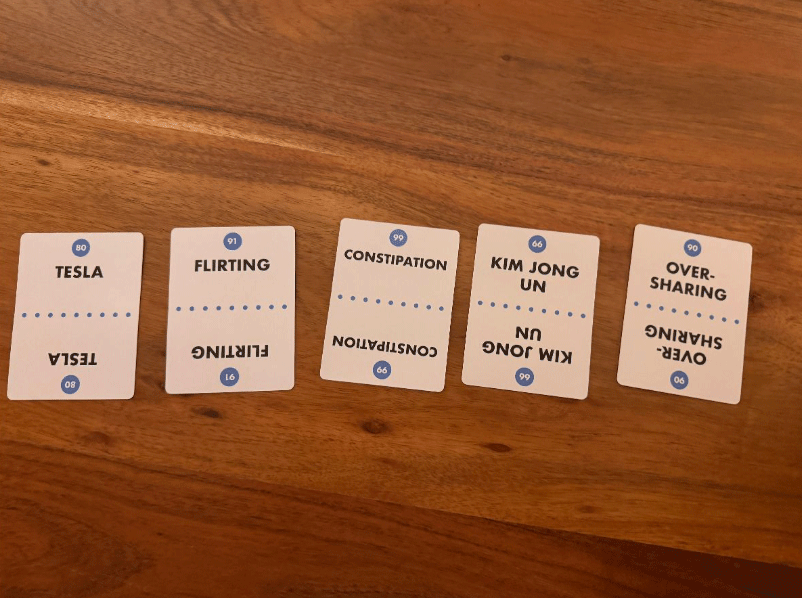
Here's an example from when "kitten friend" played Priorities with her family over Christmas. (Pretty certain these are not in the final prioritized order yet!)
Another friend got “popularity” in her pile. Popularity is a tricky thing: On the one hand, who doesn’t want to be well-received and maybe even admired? Would you rank it above “dirty laundry” or “noisy kids”? “Probably” for the former and “maybe” for the latter — depending! But if others are enthusiastically clamoring for popularity — and especially when they’re acting exclusive because of it — many of us might recoil and rank it with, well, kittens. Because what does “popularity” even mean?!
Just as we can’t predict how even our closest friends might prioritize all these random things, no one — and I mean NO ONE, not even the mighty algorithm — can predict everything that becomes popular.
***
In September, the New York Times published a long piece about the blockbuster memoir The Tell by Amy Griffin. The headline was “The Billionaire, the Psychedelics and the Best-Selling Memoir.” Maybe you’ve heard of the book: It was an Oprah pick, and it engrossed readers everywhere with Griffin’s (illegal) psychedelic drug therapy and subsequent uncovering of repressed memories of childhood sexual assault. I read The Tell in two sittings several months ago. Griffin’s memories are heartbreaking. Still, the book had some critics.
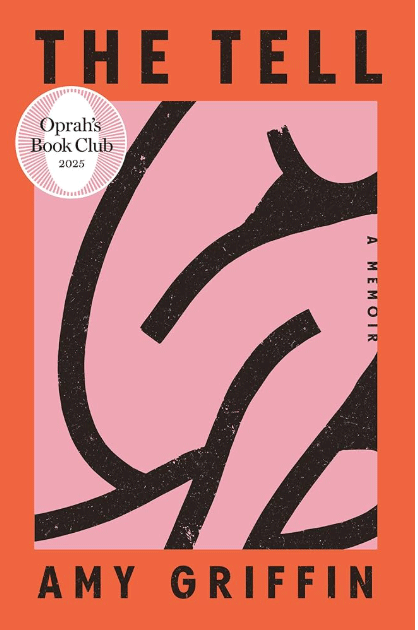
One critic is a writer named Rob Tonkin, who has self-published a memoir titled Asshole about his own childhood trauma and how it shaped his quest for success. After reading the aforementioned article, he understands that “The publicity [for The Tell] wasn’t just a tidal wave; it was a carefully cultivated network of friends and business partners.” I don’t know what I think about the rest of what he writes, but he’s not wrong about the trajectory of The Tell’s success. Prior to the piece, he sensed something was amiss, and now he had his “proof.” And I wonder, without having read it, what were the obstacles to his book taking off? (The obvious one is that Asshole is self-published and therefore lacks the perceived gravitas of association with the mighty publishing industry.)
All this gets to the purposes of why I’m writing. I have no criticism of the book necessarily, but what I’d been so, so curious about is why this book? And how? What caused The Tell to be catapulted into Oprah’s hands seemingly so seamlessly? The aforementioned article answered it for me.
In a nutshell:
“Social Capital” i.e. a massive ad hoc “marketing team” of the wealthy people and celebrities (particularly those in the “wellness space,” such as Gwyneth Paltrow) in Griffin’s social circle
“AI” i.e. a ghostwriter — certainly not AI per se, but someone skilled in the clipped staccato of a formulaic, edge-of-the-seat story
***
What makes a book — self-published or not — sing? What makes a book stand out despite minuscule marketing budgets from publishing houses? (Forget about “marketing budgets” for self-published authors.) What makes a book popular? In the latest NPR Books email, Andrew Limbong writes that he is “working on a story right now looking at how Virginia Evans’ The Correspondent was, arguably, the sleeper lit-fic hit of 2025.” He claims he is mostly “…curious about what about the book resonated with so many people?” I think he’s missing the point: The story here isn’t just about the book’s content (which I adored), it’s about the machinations behind the viral nature of sharing genuine recommendations.
I’ve started attending Creative Mornings events put on by Charlotte is Creative. I think of these events as one part networking and one part inspiration. Each month, attendees recite a bit of a “creed”:
Everyone is creative.
A creative life requires bravery and action, honesty and hard work. We are here to support you, celebrate with you, and encourage you to make the things you love.
We believe in the power of community. We believe in giving a damn. We believe in face-to-face connections, in learning from others, in hugs and high-fives.
We bring together people who are driven by passion and purpose, confident that they will inspire one another, and inspire change in neighborhoods and cities around the world.
Everyone is welcome.
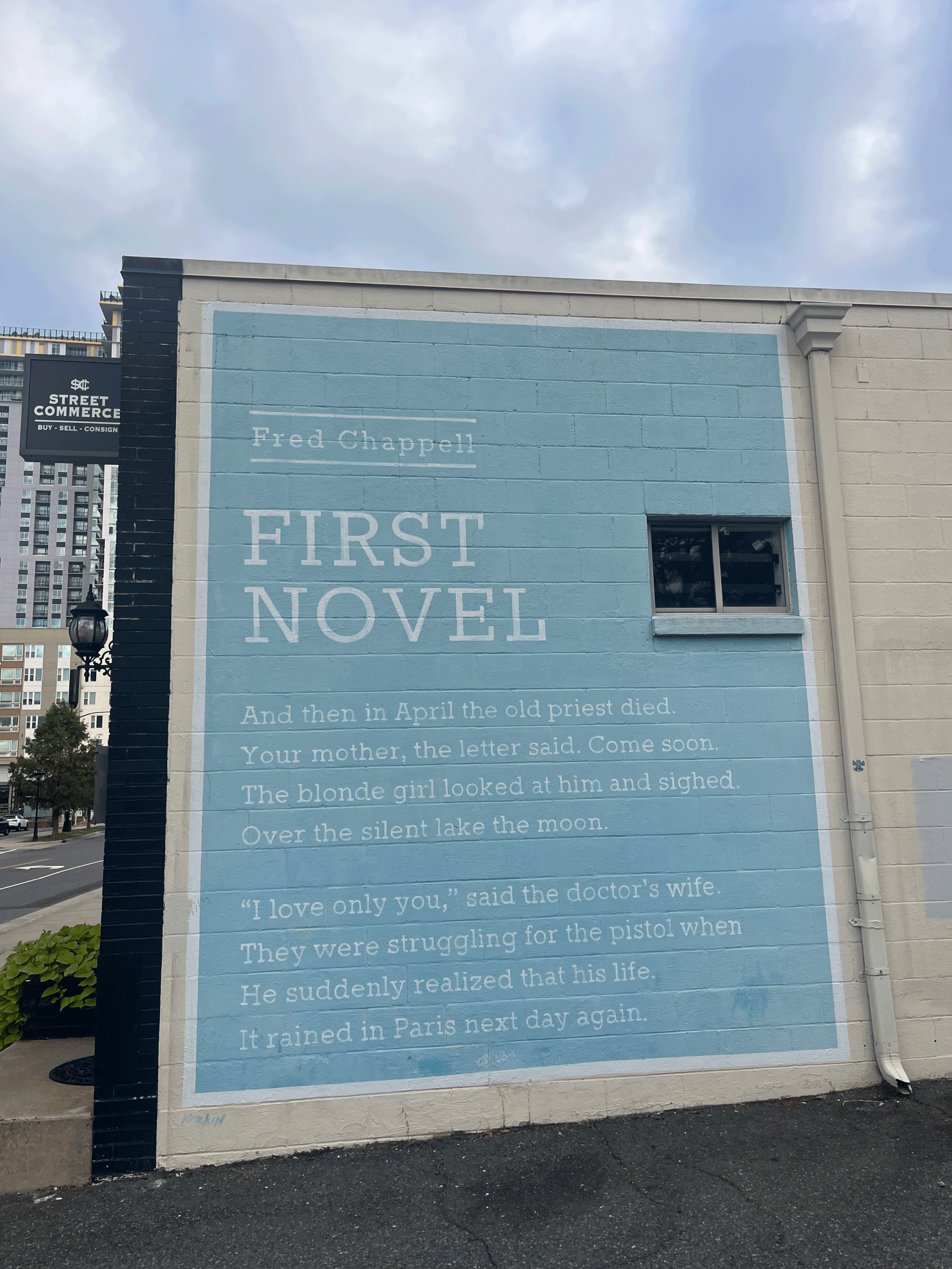
I was going to insert a pic of one of these Creative Mornings events, but the ones I have aren't great! Instead, here's a pic I took right before entering the October meeting. (Still creative, yes?!)
Did you catch that part about supporting each other? At each meeting, there are multiple ways that Charlotte is Creative demonstrates this quality — from small financial grants to allowing attendees to pitch an event/initiative/business — and its leaders make no quibble that “social capital” is not just a “thing,” but that it’s important.
It’s easy to put a negative spin on “networking,” but it doesn’t have to be an exclusive term designated for only those in traditional power. In other words, it’s not just for the popular. It can — and should — be about an innate sense of sharing, uplifting, and understanding that everyone (yes, truly, everyone) has something to offer. Popularity may (or may not) follow.
***
Word of mouth is social capital.
Recently, I’ve read two books that have benefited from social capital. I received a third book for Christmas that fits in this category, but I haven’t read it yet. In other words, I know of three recent books that came to me — and possibly the majority of other readers — via word of mouth. One was initially self-published, one is published by an independent literary press, and one is published by one of the Big Five. All are currently on the NYT Bestseller List. I’d argue they were all underdogs. In fact, the New York Times wrote that right HERE.
The books are:
The Correspondent by Virginia Evans
Theo of Golden by Allen Levi
Mona’s Eyes by Thomas Schlesser
Word of mouth — which is a way of saying boots-on-the-ground social capital — has been the main propellant for these books. But perhaps that is becoming less unusual: According to the most recent edition of Book Gossip, New York Magazine’s monthly newsletter, “Word of mouth matters most for book sales. Listicles and reviews got zero votes in this category.” These are from results of a “state of the publishing world” survey that Book Gossip administered; it’s based on replies from 28 respondents (agents, scouts, writers, publicists).
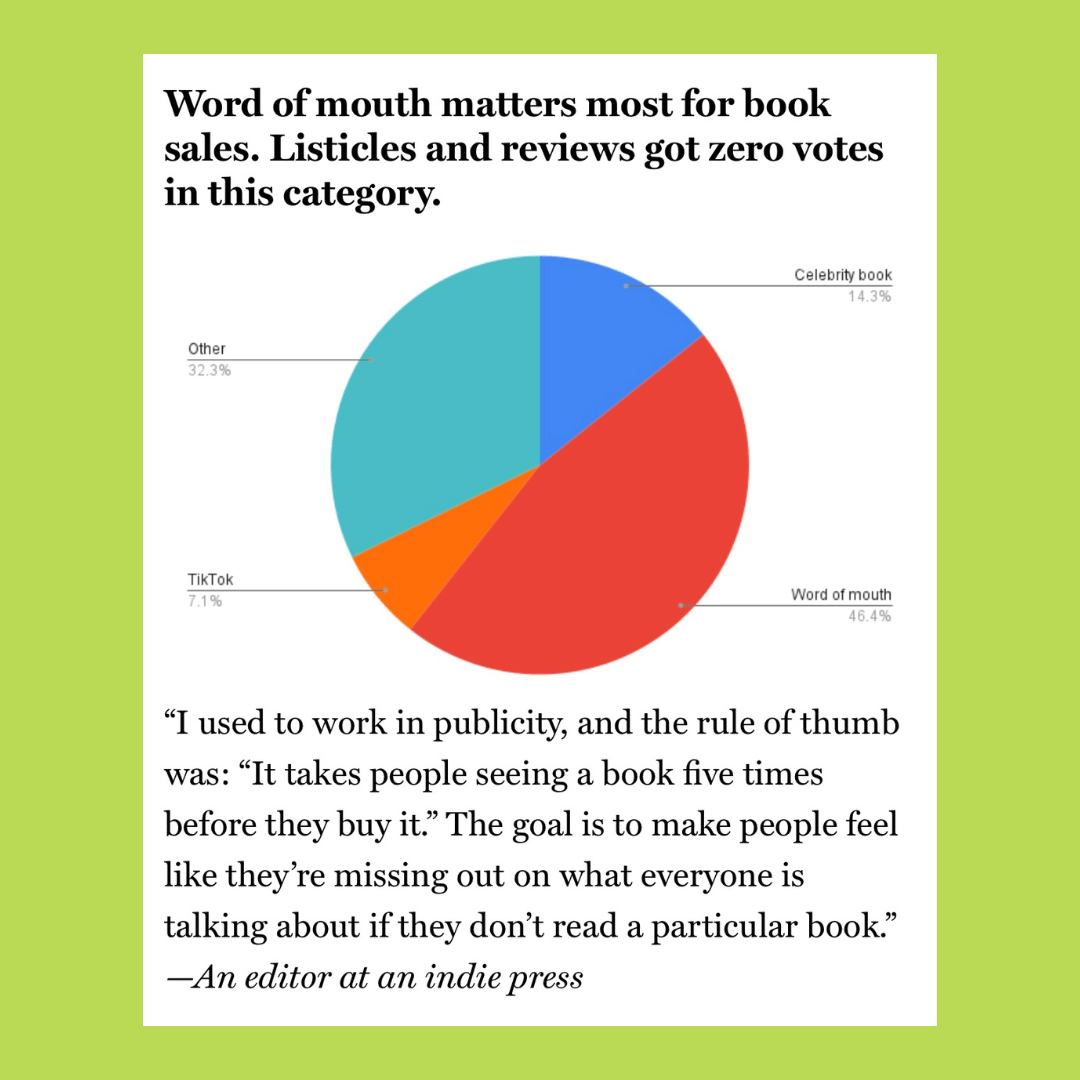
Graphic from Book Gossip newsletter, 12/18/2025.
Here is how it has played out with the books mentioned above:
For The Correspondent (loved it, btw!), the headline accompanying a Wall Street Journal piece about the traditionally published novel was this: “She Almost Gave Up. Now She Has the Year’s Unlikely Hit Novel.” As the piece states, “The Correspondent hit the New York Times bestseller list five months after it was published in April—an unlikely feat. Most books that make the list do so immediately after publication when weekly sales are typically highest.” To be fair, one person who helped with The Correspondent’s word-of-mouth traction was Ann Patchett (who also, sort of, appears in the novel). “Patchett believes word-of-mouth made the difference. Whenever she goes to the grocery store or is walking her dog, somebody stops her to say they are reading the book. ‘The only thing that sells a book is one person reads it and tells two others to read it,’ Patchett said in a phone interview.” (The beloved Patchett regularly shares her own finds via social media — a 21st-century version of word-of-mouth — on her “If you haven’t read it, it’s new to you” segments.)
In the case of Theo of Golden, I heard about this book by someone who personally knows the author. I am not part of this circle (only tangentially because we know many people who are), but I fully believe that the network of people affiliated with the Christian organization Young Life in the Southeast US is what made this self-published book a phenomenon. The NYT article doesn’t go into that much depth, but indeed, the social capital of people somehow connected to Young Life absolutely, 100 percent made all the difference. Levi initially published this book himself, but Atria Books (an imprint of Simon & Schuster) has now acquired it. It is on the NYT bestseller list…can you imagine!?! Although Theo of Golden was a just a tinge too saccharine for me, it holds a beautiful message of community, grace, and seeing the gift of every individual life. I’m not surprised that it has resonated with people in these unsettling times. It’s similar to The Alchemist, but more outward-facing than inward-facing.
My parents gave me Mona’s Eyes for Christmas, but I haven’t read it yet. It is published by Europa Editions and sold well in France. The English translation took off after a few booksellers at different Barnes & Noble locations noted its French success, saw something they liked and — voilà — this approval snowballed into the popular longstanding chain recognizing Mona’s Eyes as its Book of the Year, which is one of the biggest boosts a book can have. A French phenomenon crossing over to become an American phenomenon flummoxes me! And it has flummoxed James Daunt, CEO of B&N, too: “I would have expected it to sell in intellectual circles and to do well in Brooklyn, not necessarily to be shoveling it out the door in Middle America.”
There ya have it: Social capital at its finest, just like how Charlotte is Creative believes it should be.
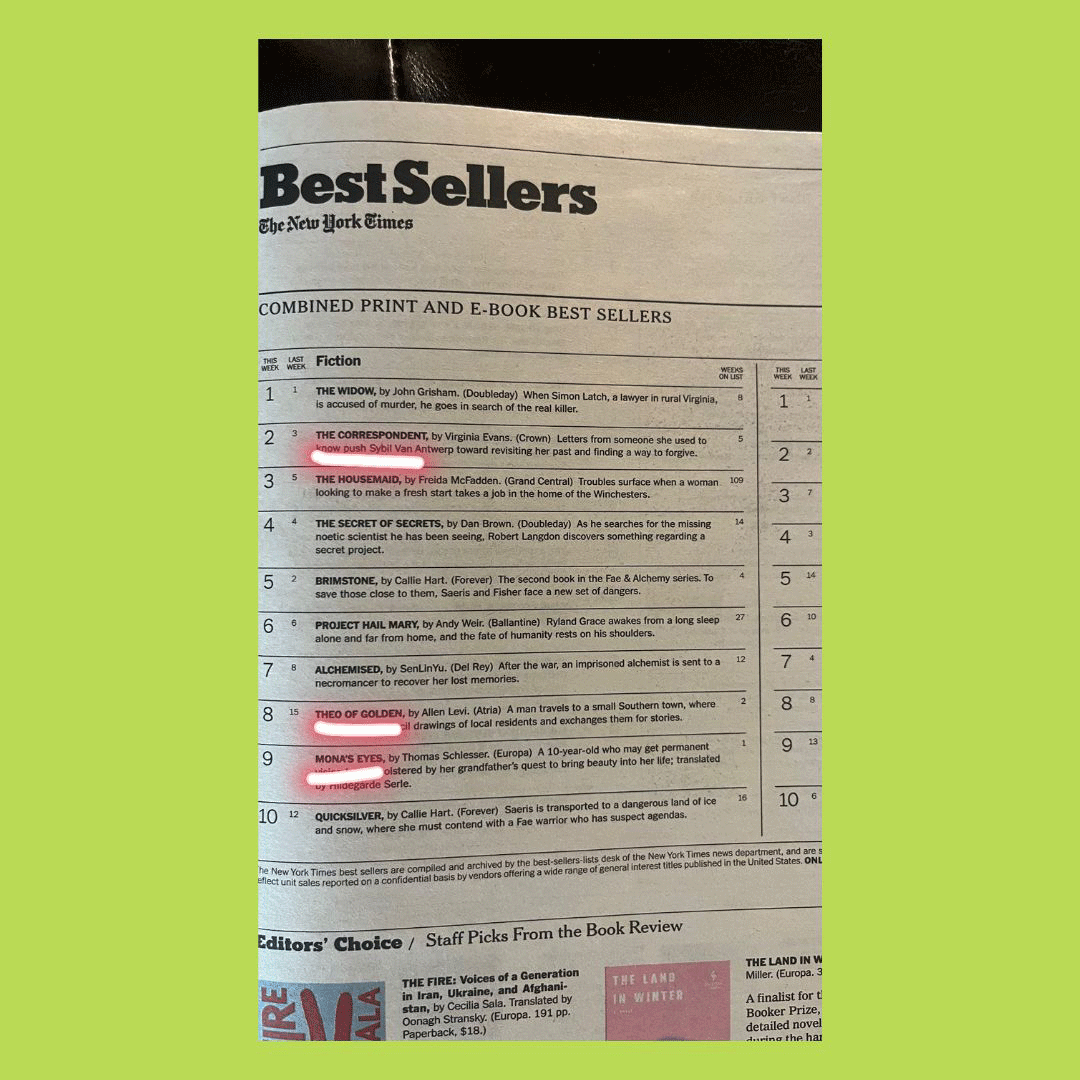
The Correspondent, Theo of Golden, and Mona's Eyes all sharing space on the NYT Bestseller List, 12/28/2025.
But What About AI?
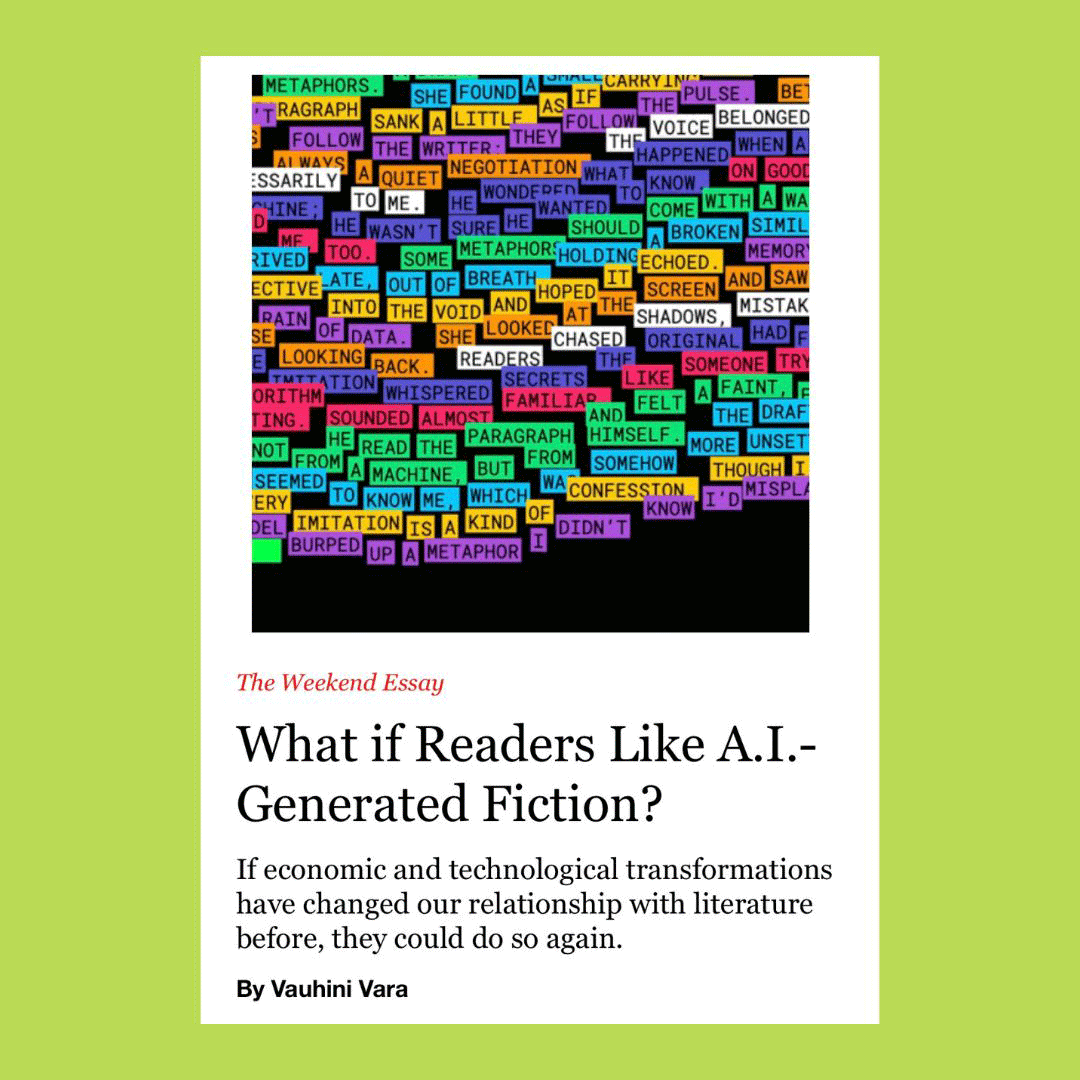
So, how do I think AI plays into all of this? (And why am I tenuously comparing ghostwriting to AI?) Last month, the New Yorker published a piece called “What if Readers Like AI-Generated Fiction?” It chronicles a computer scientist (and, I’m deducing, a literature lover) named Tuhin Chakrabarty who wanted to explore more deeply this notion that AI can produce great literature. In fact, the first sentence is this: “This past year, a computer scientist named Tuhin Chakrabarty tried to coax artificial intelligence into producing great writing.” His first conclusion after using typical LLMs (large language models such as OpenAI’s GPT-4, which is what ChatGPT uses, or Google Gemini) to “write” in the style of Nobel laureate Han Kang was that they weren’t much good: In blind tests, students — including those doing graduate work in creative writing — consistently gave major thumbs down to LLM-produced writing.
I do think there are many readers who would be content with AI-produced writing that follows a certain narrative arc with cliffhangers at the right time and the right assemblage of stock characters. After all, there are already well-documented formulas for this (and perhaps The Tell followed them). Many like the comfort of predictable rhythms — it’s only human nature! I’m not going to go as far as to say ghostwriting = AI — but a successful ghostwriter becomes, well, successful because he or she can write in a succinct, perfunctory, and engaging manner with words that are easy on the ears (and eyes, I guess). Ghostwriting is like speech-writing. (And btw I think AI is going to come for both of those professions before it comes for literary fiction.)
But Chakrabarty wanted to explore further, and spoiler alert: The extremely fine-tuned program that he created sometimes tricked even some writers’ closest friends. The author of the piece, Vauhini Vara, whose debut novel The Immortal King Rao was a Pulitzer finalist, admitted as much: “Reading the authors’ original passages alongside the A.I. imitations, I was startled to find that I liked some of the imitations just as much.” That’s not what we want to hear, is it? I suppose we can’t ignore the possibility that eventually AI may be able to write as “artistically” as someone with an actual brain — even someone with a well-above-average brain.
Yikes?
Is literature doomed? (Are we doomed?!) I don’t believe so — and here’s why:
Even if AI can write something, can it predict that people will actually read it? And like it? And furthermore — and more importantly — how will people know about it? It probably wasn't surprising that The Tell became such a phenomenon. But the other three books mentioned above — The Correspondent, Theo of Golden, Mona’s Eyes — prove that surprises still exist.
Maybe “good writing” isn’t just what you or I might deem “good” in a writerly sense. Maybe “good writing” is like “good TV” — a cultural artifact that makes you want to…
Discuss it around the water cooler,
Gab about it with friends, and therefore…
Provide it with the best kind of marketing possible: word of mouth.
AI writing — even if it’s “good” — can’t flush out what it itself “means” in a greater cultural context.
We already know that “social networks” can spread information — particularly bad information or misinformation — so I think the goal here for individuals is to keep our minds focused on real-life networks and allow ourselves to earnestly seek out things that resonate with us — and then share them! By objectively evaluating books that we read and allowing ourselves dissent when something isn’t to our standards or preferences, we are training our brains just like how companies like Google train LLMs. The more we can pick apart the idea of “popular,” the more we can, with a free will, say, “Yes, I can see why this is popular and I like it too!” or feel comfortable saying, “This popular thing isn’t for me.”
We all have some modicum of social capital! Let’s commit to prioritizing an endorsement by people we know. Don’t put the onus on AI for that.
50th Bday Book Recs

Well, well, well ... this was a long newsletter! Normally I'd more artfully display my latest reads, collate other interesting links, etc., but instead I'm going to simply direct you to my website, where you can find all of that (and more!). In addition to the usual fare, I've been sharing 50 book recommendations on the occasion of my 50th birthday, which was Dec. 26. It's been super fun! I'm only up to 30, but you can click HERE to see what I've posted so far...
Am Reading
Know someone who might be interested in periodic dispatches about books, reading, and how they intermingle with day-to-day, real life?
Feel free to forward this email and let them know they can subscribe HERE.