
Reading = Humanly Possible
from my email newsletter | issue no. 24 | April 2 2026
An Automated Life…
“Helena Kim, a stay-at-home mother in Chula Vista, Calif., decided that when she turned 59, she no longer wanted to cook. ‘I was getting groceries delivered anyway,’ she said, ‘so if I am going to order groceries I may as well order the whole meal.’ She tips well and gives drivers high ratings… Ms. Kim, now 60, adores her automated life. ‘I get Amazon delivery, I get food delivery, I get grocery delivery, I get pet food delivery,’ she said. When she does leave the house, ‘I drive a Tesla and I use self-driving mode. If I could get a robot housekeeper, that would be perfect.’”
Beep-boop, beep-boop, let’s hear it for an automated life.
The above is a quote from a NYT piece called “Freedom With a Side of Guilt: How Food Delivery is Reshaping Mealtime.” Although I found the article’s content discouraging, I have to admit that it’s the phrase “automated life” that got me more than the actual specifics. After all, as much as I’d love to extricate myself from Amazon, we do order from it enough to justify a Prime membership. (I think? May have to run the numbers…) And we do get our dog’s food and meds delivered from Chewy. (Arf!) In 2026, I have a hunch that many — if not all — of us avail ourselves to technology’s conveniences one way or another. Further, some people might even need to — and the fact that a helpful innovation exists is a very good thing.
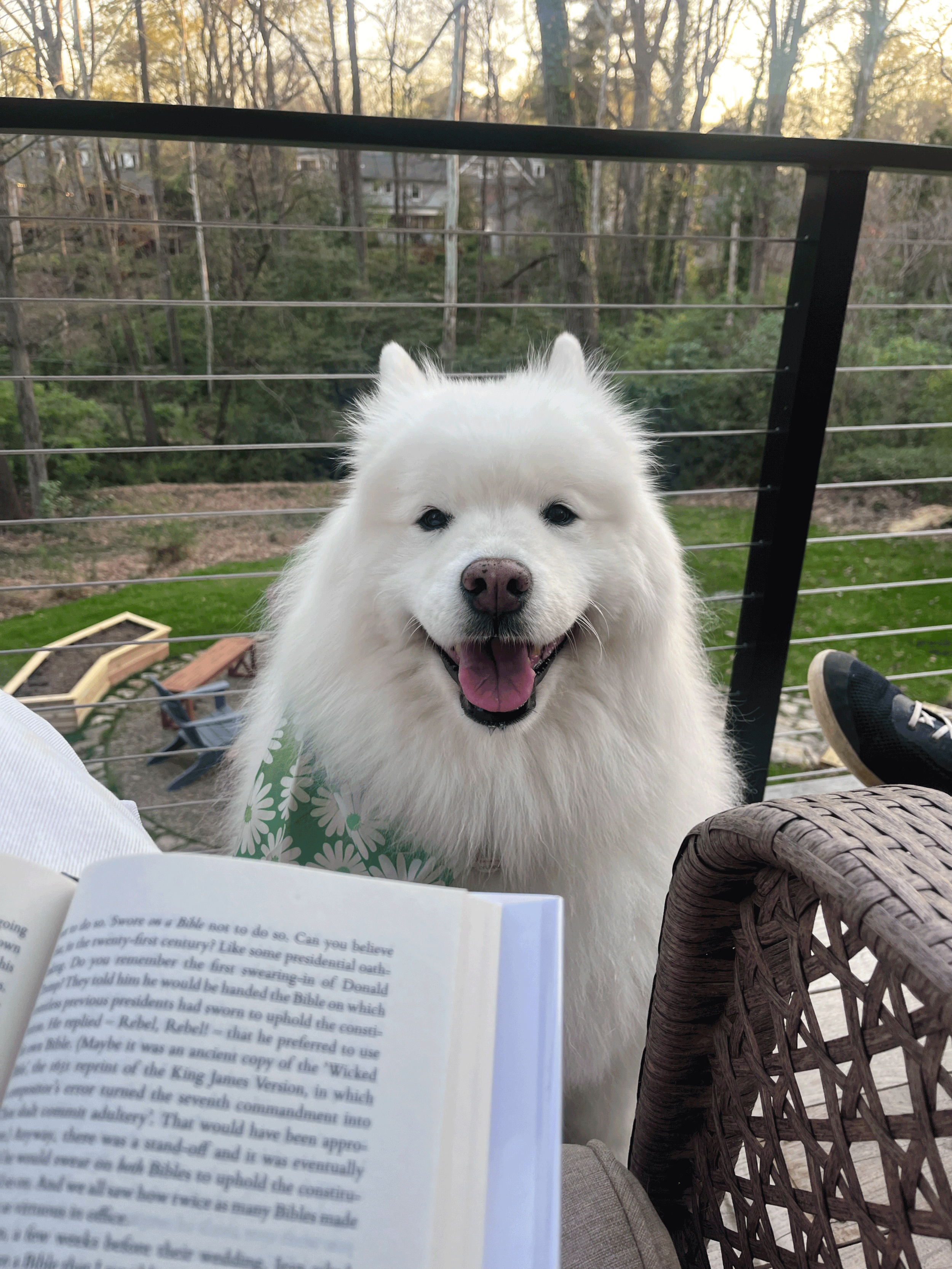
It’s a dog’s (automated) life.
For as long as I can remember, futuristic conversation has popped up every so often about a desired “magic pill” that would allow us to receive all the nutrients we need easily and seamlessly. Forget automated meal delivery…how about automated eating! Apparently a popular 19th-century orator named Mary Elizabeth Lease posited that by 1993, humans (i.e. women) would be freed from the kitchen by way of synthetic “food.” The intent of this sorcery was to bypass shopping and cooking and treat eating as purely utilitarian. Well, I can report that even though in 1993 I did enjoy copious amounts of Reese’s Peanut Butter Cups and Haribos (synthetic food but clearly the exact opposite of nutrient-rich) there still existed a need to actually prepare real food in order to survive. And more than 30 years past Mary Elizabeth Lease’s projected miracle date — and even though an abundance of convenience food items do exist — there’s a real interest in cooking (found in women and men) despite the drudgery assigned to it in generations past.
In other words, sometimes people might actually think the “inconvenience” is worth the bother.
Is Reading Worth the Bother?
When I was 3 years old, my family and I lived outside of Chicago for about a year. Of course, I don’t remember much (being 3 and all), but some stories live on in family lore: The time my mom borrowed a babysitter’s car but was forewarned that it couldn’t go in reverse so she had to pull through any parking space (!!), me repeatedly skinning my knees on the old, cracked sidewalks of Wheaton, where we lived, but mostly this: The woman who claimed that she read 100 pages in 15 minutes as part of a speed reading class that my mom was in.
Hold up: Speed reading class?! YES. For the year that my dad’s firm moved us to Chicagoland, both the men and their wives took a speed reading course through Evelyn Wood Reading Dynamics. (After looking at the Wikipedia page for this, I feel like I need to do a deeper dive on this whole operation…) But anyway, that show-off woman who claimed some outlandish reading pace? The instructor replied to her — her name was Joan, btw — “That’s not humanly possible, Joan.” (I’d say this is a good refrain to have in your back pocket. Someone annoying you with their braggy ways? Just reply coldly and authoritatively, “That’s not humanly possible.” You could even add “Joan” at the end for good measure to confuse them.)
I guess this is what happens to your eyes when you read fast!
Aside from the fact that “speed reading” is kind of a weird skill to want to acquire, ummmmm…what is the actual point? (I went heavy on AI in the last newsletter, and this one is going to be the opposite, but I do realize that the types of people who could have benefited from speed reading in 1979 are the same people who now, in the age of AI, may feel the need to inhale informational text.) But for books that are meant to be, oh I don’t know…enjoyable? “Hi, Jane. I read the latest Read With Jenna pick in 45 minutes. How long did it take you?” Or, “My name is Alice, and in one week, I read every book that James Patterson published.” Big whoop. Unless you’re going for some Guinness World Record, I have difficulty seeing the purpose of speed reading like that.
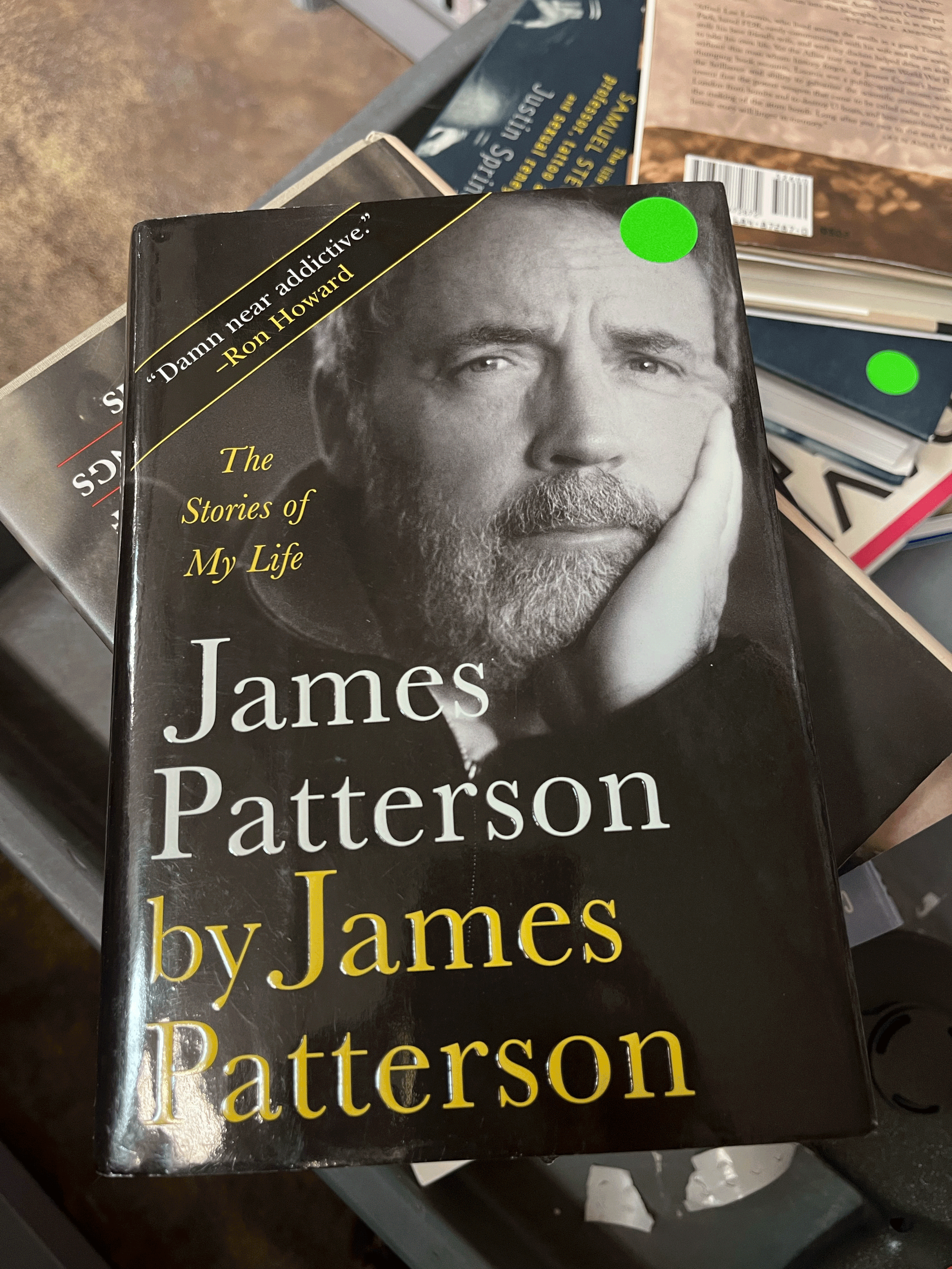
James Patterson read James Patterson by James Patterson in 30 seconds, probably.
But nonetheless, this class actually existed. (I know!!!) And to be fair, I guess the point was reading effectively and training yourself to synthesize information. (This is different than synthesizing food for a pill.) But for Joan? It kind of sounded like she didn’t care; she just wanted to read fast. She wanted automated reading.
So, what would automated reading look like? Would it be for people who might want a way to have the worlds, scenes, and overall content just placed in their brains? Anyone over a certain age knows that there is a version of this — and that is CliffsNotes. (Hello, 1993!) I guess AI summaries are the 2026 version of that. But these tools are outcome-focused instead of process-focused. And there is value in the process of reading, just as many have found value in the process of cooking and enjoying a good meal with others.
The pleasures of eating … and reading.
In an essay called “The Pleasures of Eating,” Wendell Berry — one of my favorite contemporary thinkers and authors — writes, “When food, in the minds of eaters, is no longer associated with farming and with the land, then the eaters are suffering a kind of cultural amnesia that is misleading and dangerous.” (Yeah, you could say he's anti-automation.)
I’ve enjoyed Berry’s novels Jayber Crow and Hannah Coulter so very much because they are essentially (beautifully) fictionalized versions of the nonagenarian’s life philosophy that he has spent the last six decades fine-tuning and sharing after deciding to abandon a stereotypically erudite and cosmopolitan writer’s life in NYC and Europe and returning with his family to Kentucky, where he farms, advocates for thoughtful environmental stewardship, and continues to write (andwriteandwriteandwrite) about home, community, and landscape. Two words that Wendell Berry uses frequently are “place” and “membership”; he cares deeply about the settings where our lives unfurl and how to best cherish and cultivate our souls and the souls of the people we share space with.

The novel Hannah Coulter by Wendell Berry. (Soooooo good!)
Although Berry holds a special affinity for rural populations, his philosophies are inclusive. Just because he rebuked the powers-that-be who told him moving back to “backwards” Kentucky would be a writer’s death knell doesn’t mean that he is anti-urban. Recently, after searching my library system’s database for anything by or about Wendell Berry, I found a book he wrote called The Poetry of William Carlos Williams of Rutherford. For the record, I love the poetry of William Carlos Williams. LOVE IT.
Williams was not too different from Berry in the sense that both men felt called to care for — and therefore live in — the places that shaped them. In Williams’ case, this was Rutherford, New Jersey. Berry writes, “By staying put, Williams was forcing himself to learn, however stumblingly or ‘difficultly’ at first, that the condition of the place, its health in the fullest sense, was necessarily one of the measures of the quality of the work that was done in it. Poetry, which for other poets was personal or ‘cultural,’ became for Williams a civic obligation, a kind of work relating to community membership and neighborhood.” In other words, Williams had no problem getting his hands dirty, so to speak, to celebrate and pour life into his community. Certainly as a doctor (because, yes, this was his main profession), he could have sailed along going through rote motions, but instead, he really got to know his patients and the diverse conditions that may have played a part in how they relate to their healthcare.
“Friction” is a popular term these days to describe the sometimes mundane interactions or tasks that comprise a full day. The point being that technology has eliminated a lot of “friction” from our lives. I'd argue that Wendell Berry endorses this idea of "social friction," and if he were still alive, I think William Carlos Williams would as well.
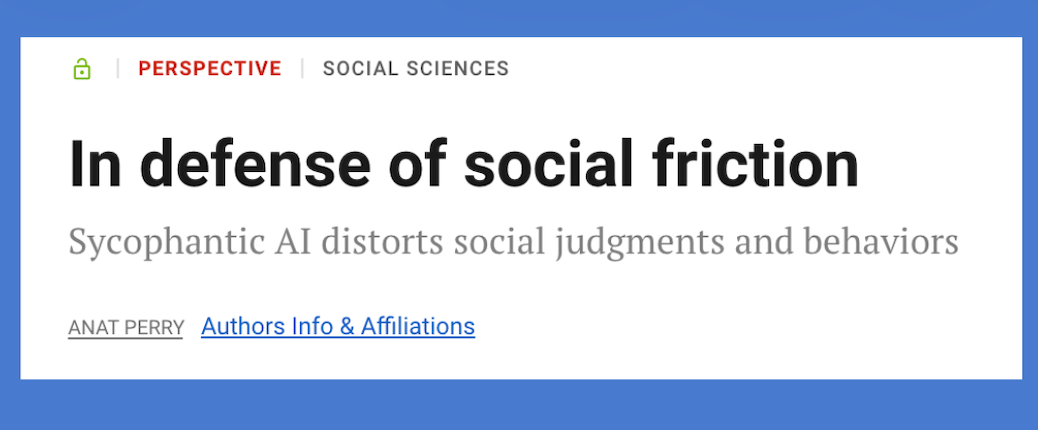
This is the headline for an opinion piece in Science magazine.
Interestingly, even though he wasn't a farmer like Berry, Williams was also a keen observer of gardening and plant life. Wendell Berry and William Carlos Williams shared an awareness of where their food came from and saw the “point” of knowing how it was produced. The process was as important as the product. Here’s one of Williams’ best-known poems, where he is appreciating a piece of fruit — the type of food that in 1938 was undoubtedly grown very nearby:
“This is Just to Say”
I have eaten
the plums
that were in
the icebox
and which
you were probably
saving
for breakfast
Forgive me
they were delicious
so sweet
and so cold
Were the plums seemingly “worth more” because they had been picked by someone and then carefully and prudently tucked away? Probably. (Do you want a plum now? I do.)
Both Wendell Berry and William Carlos Williams write about the intrinsic value of “work” — of undertaking something that could possibly be done an easier way or maybe even eliminated altogether.
Process Over Product
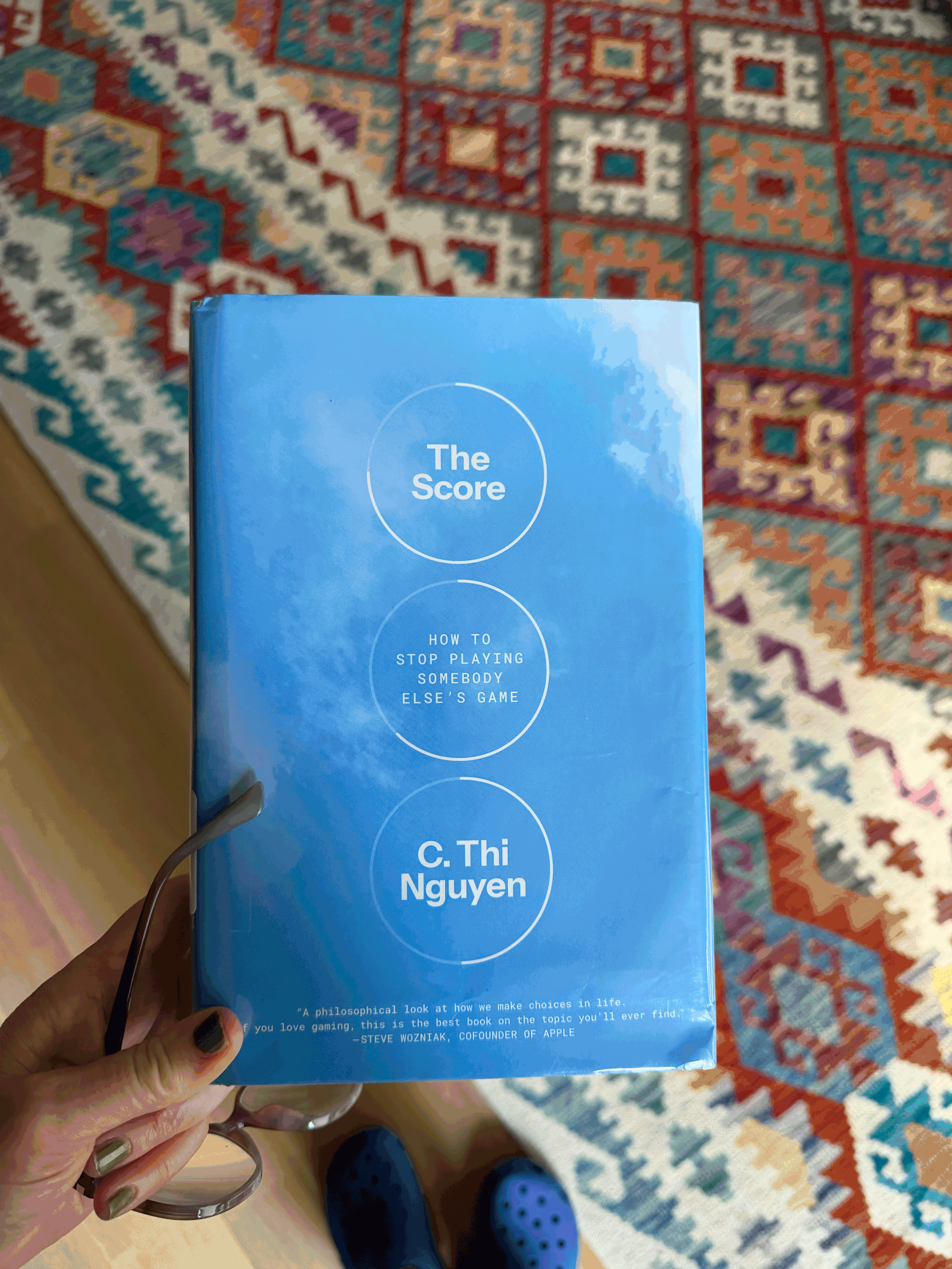
I’m currently reading a book called The Score: How to Stop Playing Somebody Else’s Game. It’s written by C. Thi Nguyen, a philosophy professor, and it’s about how scoring systems (i.e. games) help inform so much of our culture, from business practices to “success” rankings. The Score explores how we get sucked into metrics — and that these metrics don’t paint a full picture of what individuals and cultures value. In one chapter he talks about the different types of motivations that people have when playing games:
“To understand why so many of us play games, you have to remember the distinction between goal and purpose. For achievement players, the goal and purpose are one: They want to win. But for striving players, goal and purpose are very far apart. The in-game goal is just a disposable tool that they use to approach their real purpose: the experience of that delicious struggle…And this difference between goal and purpose is everywhere, far beyond games. For a lot of folks, the goal of knitting is to make scarves, but the purpose is to be buried in this pleasurable zen dance of delicate finger motions.”
See: Process over product. Speed-reading Joan was undoubtedly an “achievement player.”
But even if one were to say, “hey, I just want to win/have a synthetic food pill/download a book to my brain,” automation can’t ease the sticky parts of life. It can’t eliminate annoying — or for that matter, painful — things. Kate Bowler has sent out a short e-missive every day of Lent, and the one on March 31 was particularly good. And guess what? She quotes Wendell Berry’s novel Hannah Coulter:
“Life was requiring life of her.
Not understanding.
Not resolution.
Not even peace.
Just life.”
Neither you nor I can automate every wrinkle out of life. To paraphrase Berry, life requires life of us. There’s no escaping that! It sounds like Helena Kim of Chula Vista really enjoys what automation has done for her, but at some point — even if she continues on her “automation journey” — she’ll hit a roadblock. Perhaps there are some things it makes sense to automate (food delivery for a busy household, for example), but there are other cases where automation is undesirable — even if it were possible. Personally, I’d put reading in that category. A) I enjoy it and it grounds me. (You can read my thoughts on that here.) B) Perhaps ignoring shortcuts and embracing the “friction” of things like reading or eating — things that, maybe, could be automated — gives us the fortitude and muscle memory for when we encounter tough and trying things in life that truly cannot be automated.
PS: One of my favorite lines from Hannah Coulter is kinda perfect in its blunt simplicity: "Books were a dependable pleasure." (Amen!)
Latest Reads
I'm bringing this feature back! Btw, when I say Latest Reads, "latest" = since I've last done a round-up in this newsletter. I know it looks like a lot, but I'm no speed reader! (Maybe I need a class.) These are books I read over the past several months. Feel free to screenshot or save the graphic to keep handy next time you're looking for something to read. You can click through the links below to see what I've written about these books. (PS: On Instagram and my website, I've been doing a round-up of my Top 50 Books on the occasion of my 50th bday. I'm up to 38 [50 is a big number, y'all!!!], and you can find those HERE.)
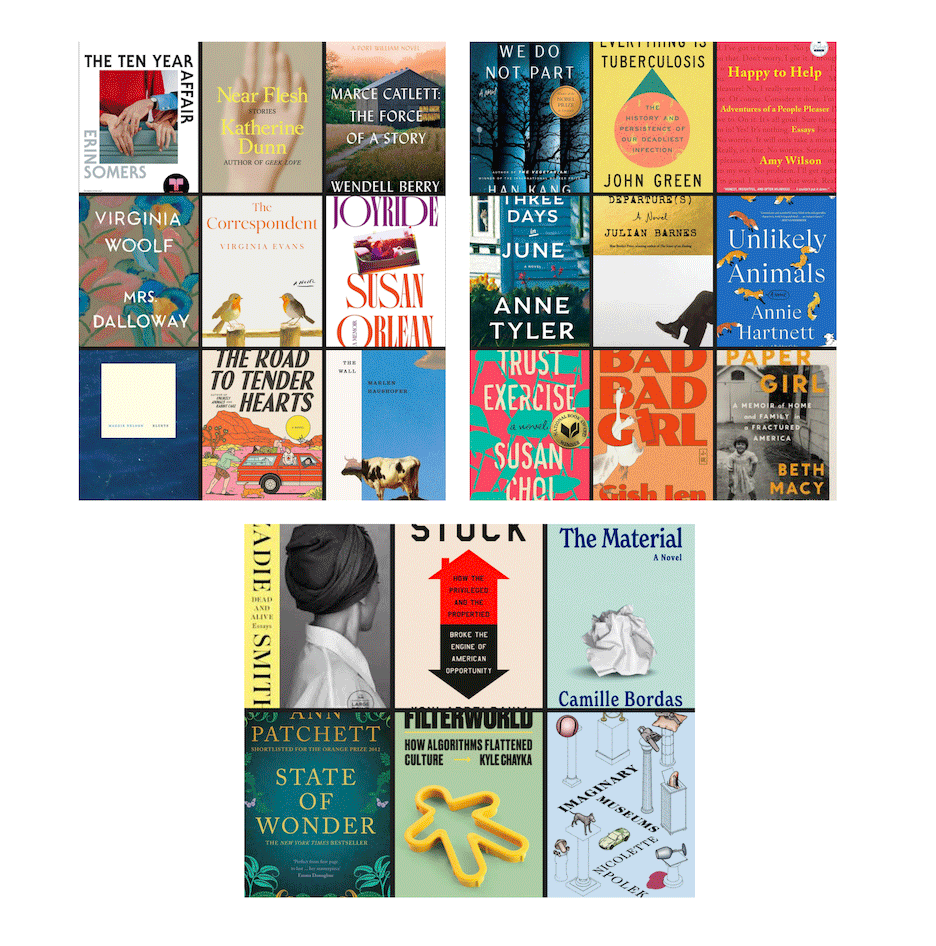
The Ten Year Affair by Erin Somers
Near Flesh: Stories by Katherine Dunn
Marce Catlett: The Force of a Story by Wendell Berry
We Do Not Part by Han Kang
Everything is Tuberculosis by John Green
Happy to Help: Adventures of a People Pleaser (Essays) by Amy Wilson (awesome name!)
Mrs. Dalloway by Virginia Woolf
The Correspondent by Virginia Evans
Joyride: A Memoir by Susan Orlean
Three Days in June by Anne Tyler
Departure(s) by Julian Barnes
Unlikely Animals by Annie Hartnett
Bluets by Maggie Nelson
The Road to Tender Hearts by Annie Hartnett
The Wall by Marlen Haushofer
Trust Exercise by Susan Choi
Bad, Bad Girl by Gish Jen
Paper Girl: A Memoir of Home and Family in a Fractured America by Beth Macy
Dead and Alive: Essays by Zadie Smith
Stuck: How the Privileged and the Propertied Broke the Engine of American Opportunity by Yoni Appelbaum
The Material by Camille Bordas
State of Wonder by Ann Patchett
Filterworld: How Algorithms Flattened Culture by Kyle Chayka
Imaginary Museums by Nicolette Polek
Read This!
(i.e. some quick links)
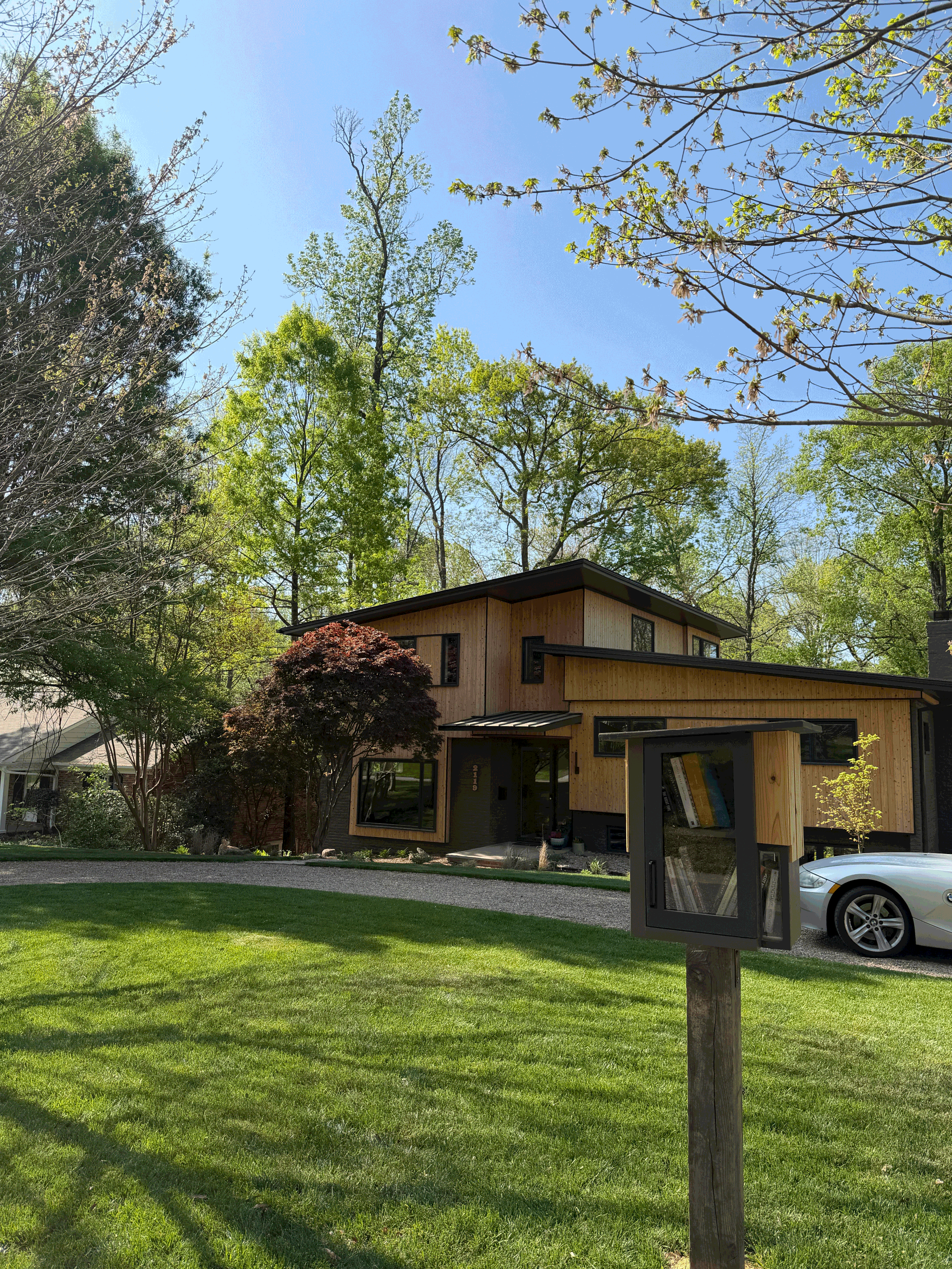
Everyone loves a Little Free Library, amirite?! In addition to posting my thoughts about specific books, my website (and Instagram account) also houses writing that I've categorized the following ways:
Book Culture: posts about reading habits, publishing trends, libraries/bookstores, etc. Like this one that features Matt's public debut (fancy!) as a woodworker (uh, he's still got a day job, but yup, that's his handiwork in front of our house!), thoughts on Denmark lowering their VAT on book purchases, and luxury fashion brands embracing The Book as a fashion accessory.
Musings on People + Places: posts about things that strike my fancy, but that usually pertain to home + place, migration + culture, community + connectedness.
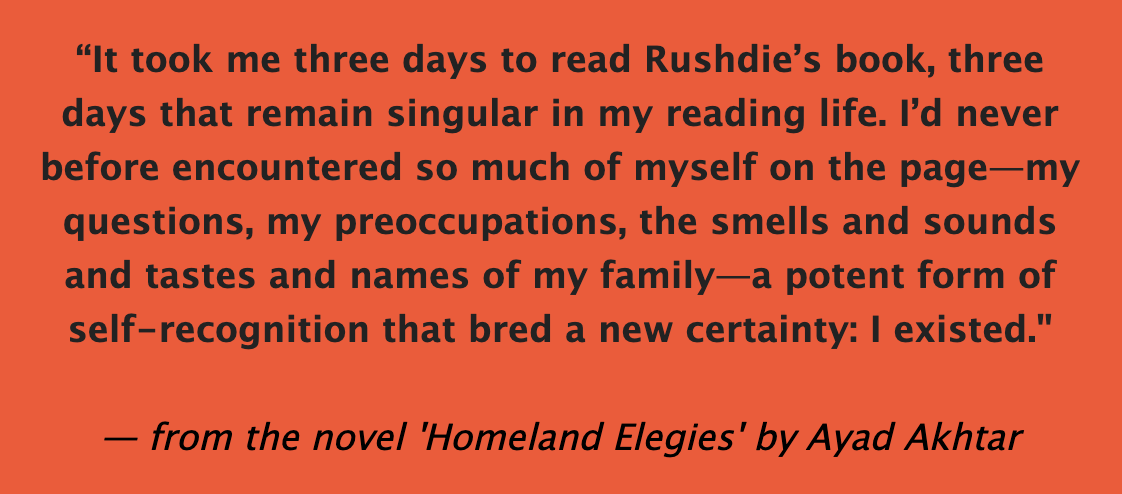
Pull Quotes: I love it when a line from a work of fiction or a piece of poetry lets me riff!
Am Reading
Know someone who might be interested in periodic dispatches about books, reading, and how they intermingle with day-to-day, real life?
Feel free to forward this email and let them know they can subscribe HERE.