

READ ALL ABOUT IT
Since 2012, I’ve been writing about books. And the act of reading. And the importance of story and narrative. But, mostly, the underlying theme of all I write is how taking a moment to stop and digest some longform text — instead of scrolling, instead of watching a video, instead of multitasking — can be one of the most grounding things we can do for ourselves. Here’s the one-stop online home for all this writing.
You can read more about me and my work by moseying over here. Want to peruse periodic “essay drops” — excerpts from my work-in-progress essay collection about Homesickness? Here ya go.

Colored Television
There’s a lot in this book that touched a nerve for me (namely, bouncing around rentals with young children due to affordability and/or landlord nastiness…been there, done that in NYC and Dublin) and there’s a lot that may touch a nerve for others that I can’t necessarily relate to (navigating different cultures as a biracial person)…

Playground
I was a pool rat when I was a kid, and each decade since childhood, I’ve faithfully returned to the water — albeit often with yearrrrrs in between. Each reinstallation of the Swimming Routine summons (faux) existential angst about things like buying a new lock, new cap, new goggles; understanding the ins and outs of the location (like the time I was convinced I was “locked out” of the pool but it was just that I was a whole hour early for open swim…cue me banging on the door like a lunatic until I just decided to sit in the sauna 🫠🥵), wondering if muscle memory will take over. (It always does.)

Choice
“Make good choices!” is the de facto cry of parents. Which in one way is the same as my parents telling me to have a safe flight … of course we all know I have no choice in the matter. My point being: Telling your child to make a “good choice” really doesn’t actually do anything except make a parent feel better via a false sense of control because navigating “making good choices” is sort of this specter that hangs out in the ether throughout years and years of parenting. You hope that common sense just sort of rubs off on them as you model good choice-making, but it’s not like you can role-play or narrate every single situation that a child might encounter. (But of course we all know the general highlight reel…)

Margo’s Got Money Troubles
Margo’s Got Money Troubles…people adore it. Apple is adapting it for TV. The gist: Margo is a 19-year-old community college student who gets pregnant by a professor. She decides to keep the baby. Yes, it’s a take on power and how people — particularly young ones — can find themselves in tough situations, yadda yadda. The aforementioned analysis is very true, but it’s sort of like saying this about a book: “It’s trying to say that everyone is equal.” Or, “We should love each other.” We know!!! (Or rather: Most of us know.)

Reading is Grounding
Until we moved, we were daily newspaper subscribers — meaning actual, physical papers. (We’ll get back to it!) I have a hard time keeping up digitally (we have a handful of digital news subs) partly for the reasons that Cal Newport discussed in a newsletter about unplugging (for a bit) after you vote: “I suggest you switch to a slower pace of media consumption. Don’t laugh at this suggestion, because I’m actually serious: consider picking up the occasional old-fashioned printed newspaper (free from algorithmic optimization and click-bait curation) at your local coffee shop or library to check in, all at once, on anything major going on in the world.” Personally, I like to see the news laid out in one place, not click around on some rabbit trail.
More wisdom-seeking
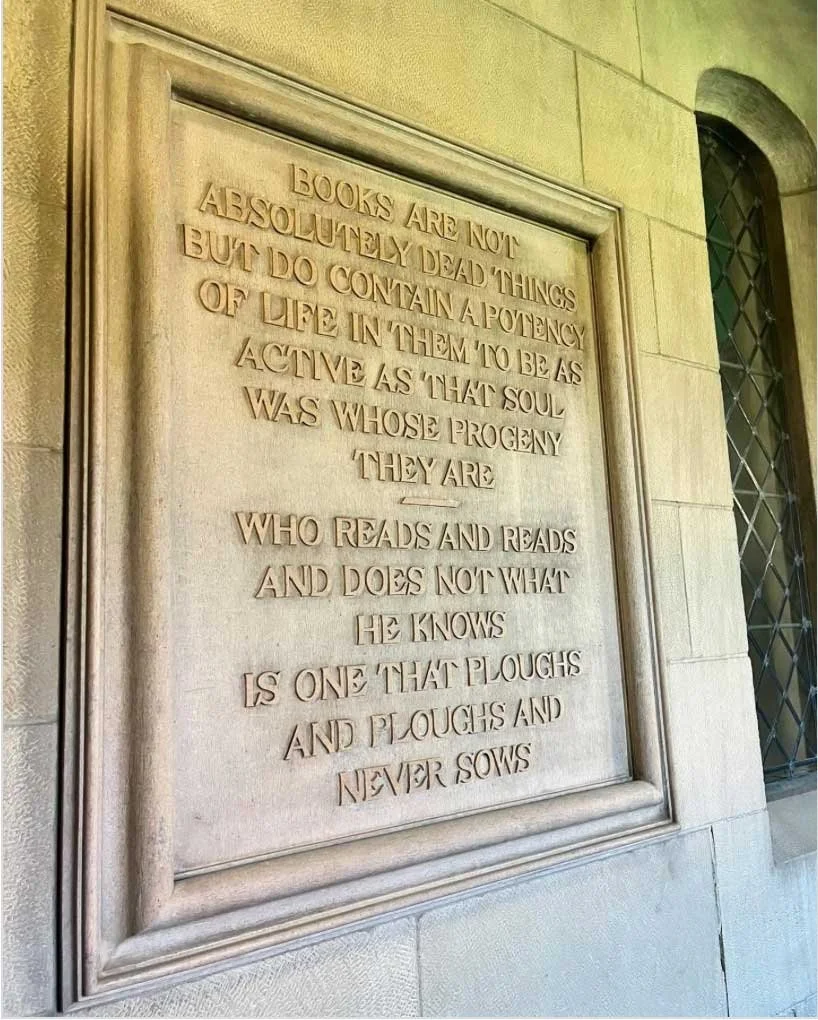
A plaque in the vestibule of Bowdoin College’s former library:
“Books are not absolutely dead things but do contain a potency of life in them to be as active as that soul was whose progeny they are.” This is from John Milton’s “Areopagitica,” which (I’ve learned) is one of the standard-bearer prose polemics (basically a speech/argument — which I’ve also learned) in defense of free speech. It was written in 1644, but of course like other persuasive writings packed with wisdom, lives on. For better or for worse, there’s not much new under the sun, right?

Tell Me Everything
Oh, this one just might be my favorite. It likely isn’t most people’s favorite Elizabeth Strout novel (too many good ones to choose from!) — and pretty sure I wouldn’t recommend Tell Me Everything as anyone’s first foray into Strout’s catalog — but I think this is still my favorite.

The Editor, Having and Being Had, Slow Productivity, The Work of Art
Here’s Part 2 (of 4?) of a roundup of nonfiction I’ve read lately. Some of these I’ve read with an eye toward my own writing (style, subject, etc.), some were just for fun.

The Women Behind the Door
Sometimes I feel like I grew up as a reader in tandem with Roddy Doyle’s journey as a writer. In college, my parents gave me Paddy Clarke Ha Ha Ha, Doyle’s 1993 Booker-winning novel. I was mesmerized by the cover and even more mesmerized by the dialogue (some of which was hard for me to decipher).
Reading Our Way to Better Taste
From Newsletter Issue No. 19:
In July, the New York Times published a comprehensive roundup of “The Best Books of the First Quarter of the 21st Century.” How were these titles agreed upon? Well, they were “voted on by 503 novelists, nonfiction writers, poets, critics and other book lovers — with a little help from the staff of The New York Times Book Review.

Put a Little Book House in Your Soul
It’s that time of year 🍂🍁🍂🍁

The Safekeep
People will say The Safekeep is a love story, or people will say The Safekeep is about how WWII affected a country, but the magic of Yael van der Wouden’s debut is a house and how a structure’s story changes depending on who occupies it. A structure will always = shelter, but is this shelter fair, just, or healthy? “Bound to this house, he said. As if it was a tether and not a shelter.”
Ghost Wall
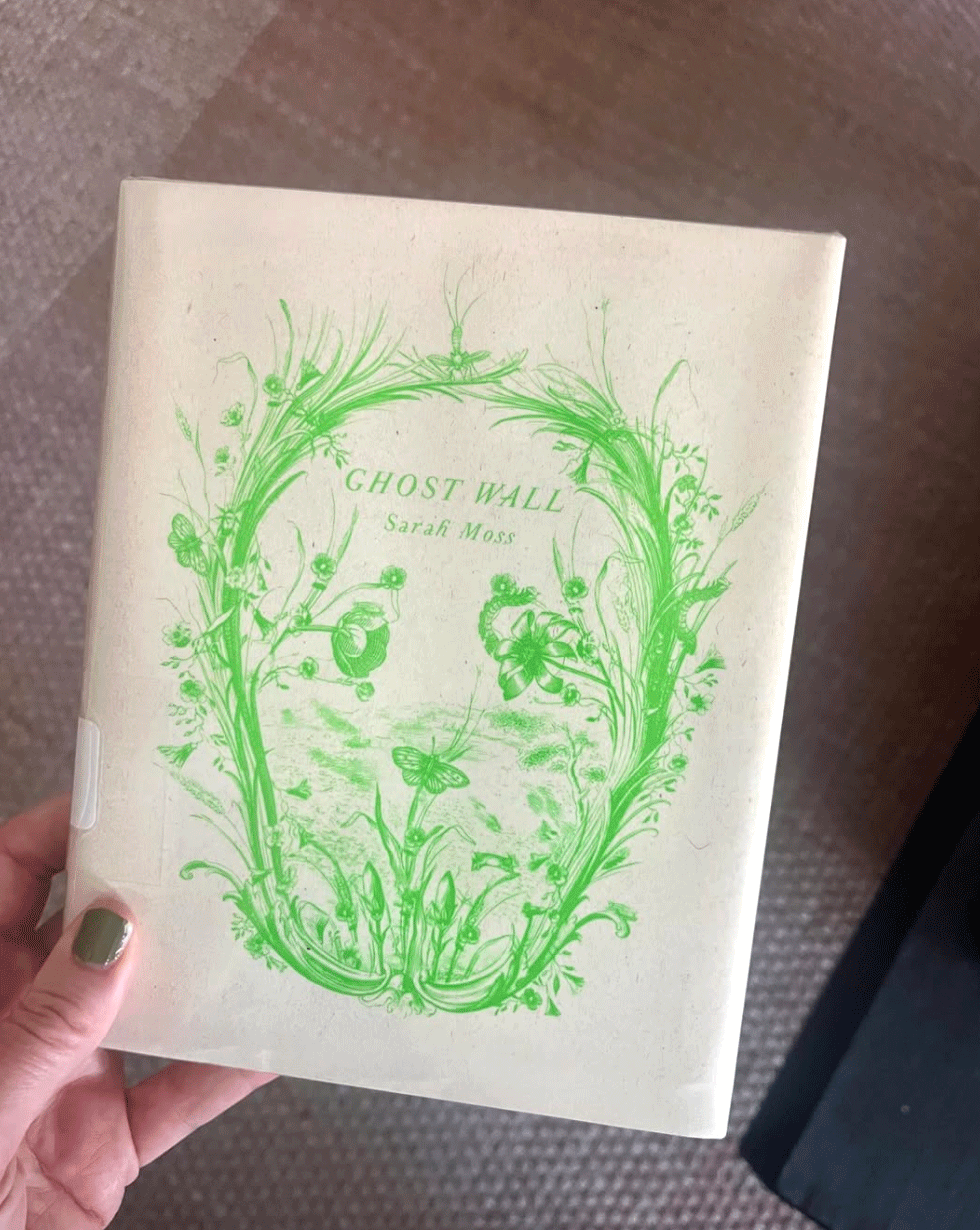
“Packs a punch.” “Good things come in small packages.” “Punches above its weight.” (Weird how ‘punch’ does double time when it comes to idioms about outsize force relative to size…guess we really do think of impact vis a vis mass?) Those are a handful of annoying phrases that one could use to describe a “small but mighty” (ugh) book. “Slim.” “Compact.” “Trim.” “Slender.” All ways that short novels are described. (No shame there — I’ve used them all.)

A Beautifully Furnished House
Two days wandering New Orleans, and I think this is my favorite picture? (Ok, that’s not totally true…so many bright, beautiful, and interesting things to see!)
But 2 days wandering New Orleans = 3 bookshops visited. I try really hard to not buy new (meaning new releases) books these days. (This is why I currently have 20 books out from the library. OMG.) But I do like to support independent bookstores, so my new book-buying philosophy =

Creation Lake
It’s like when you’re sitting in a window-filled room and the clouds start moving juuust a smidge so that when the sunlight peeks and then recedes you nonetheless feel your entire mood fluctuate with these subtlest of shifts. Quietly provocative.

The Ease I Feel
“And so the days pass. I keep waiting for something to happen, for the ease I feel to end.” These are the words that Claire Keegan gives to the narrator — a young Irish girl sent to live with distant relatives — in Foster. The girl is in the middle of a gaggle of siblings, and the reader guesses that it is the imminent arrival of yet another baby that prompts the girl’s migration from a chaotic home with hints of trouble to the tidy, childfree Kinsella home where she is told to “make [herself] at home.”

Love and Trouble, Monsters, House Lessons, The American Idea of Home
I’ve been meaning to do a roundup of nonfiction I’ve read in the last few months. Some of these books were read with the intent of observing format and style for my own writing, but the subject matter is fascinating too. So, win-win. (I mean, could you have an interestingly written book about something boring? Of course. But it wouldn’t come across as boring. Therein lies the quandary…)

The Buddha in the Attic
I’m sure you know about author Chimamanda Ngozi Adichie’s wildly popular 2009 TED Talk “The Danger of a Single Story.”

Obsessed With Home
Obsessions go hard, I guess. It’s not a shocker that I’m obsessed with the idea of home — and, specifically, that complex feeling of homesickness, which is its flipside I suppose. Matt and I are just about done emptying the house that will be undergoing a big ol’ renovation, and today I came across a box of all my old clips from the Tufts Observer. Here’s the first thing I ever wrote for the publication where I eventually creeped my way up to Editor-in-Chief. Color me surprised. (Not at all.) I didn’t know what I was writing, really; I just knew that my background and points of reference were a little different from the throngs of students mostly from NJ, NY, MA, and sometimes CT, so I guess I needed to get pen to paper to make sense of that somehow. The specter hanging over all this wondering via simplistic writing was my parents’ cross-country move to Washington, DC right before I wrote this. (ie Where is home?!?!)

RAWTS: The Nix
I shared this a few weeks ago in stories, but it needs to be here on the grid. Matt is back. Meaning, he’s back in his Reader Era. Figured today — our 24th anniversary — was as perfect a time as any to post.
